Showing posts with label czech. Show all posts

Taste the Volcanicity!

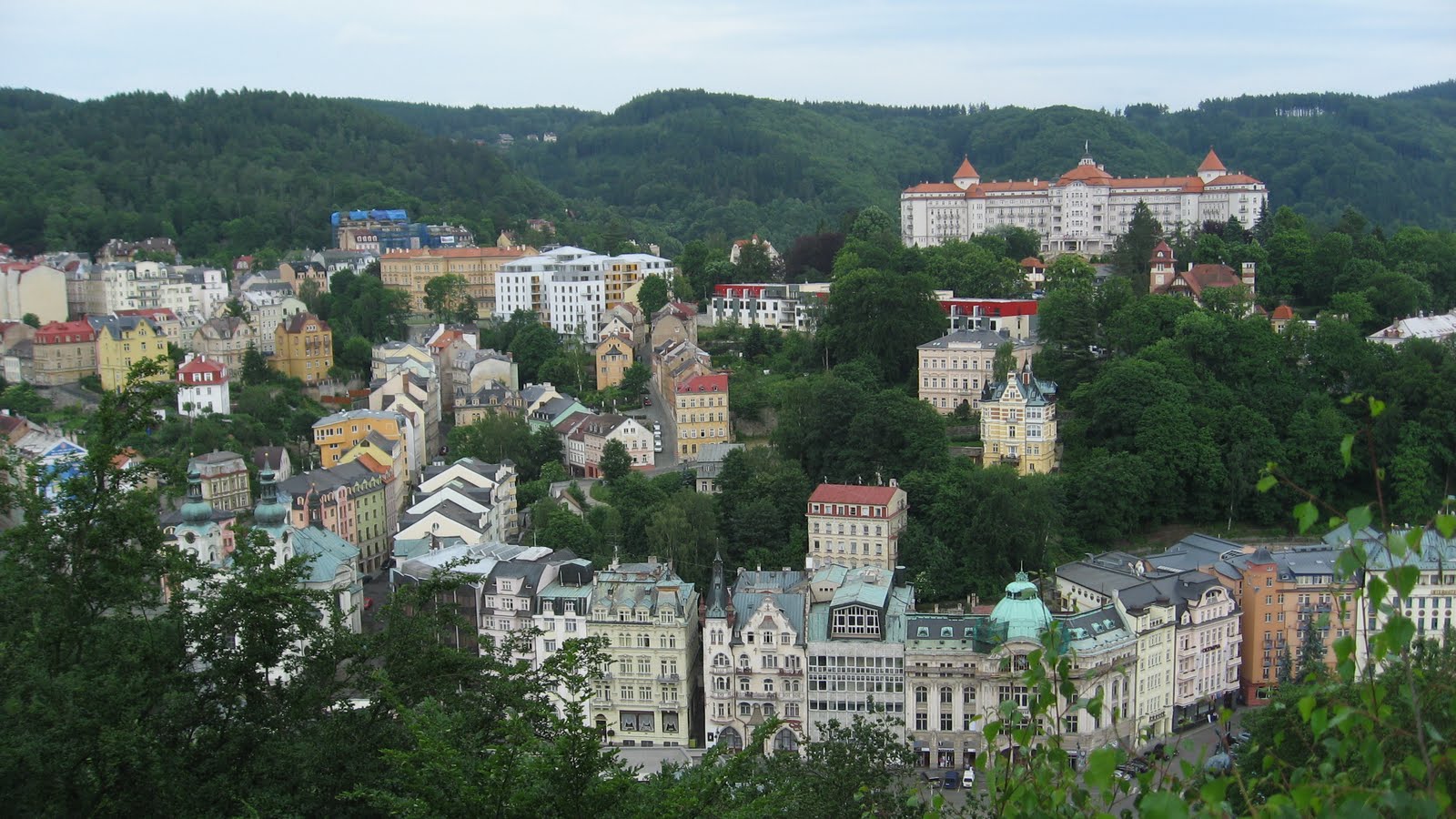
Time continued to tick away during my last few weeks in Prague, and before I left the Czech Republic there was one more place I wanted to see: Karlovy Vary, a spa town, where one can drink the natural mineral water that shoots up from the subterranean hot springs. Supposedly the salty-tasting water will cure what ails ya, but who knows. The town is also the home of an international film festival that attracts many tourists each year in the beginning of July. As I couldn't be around for that, I opted instead just to explore a few of it's scenic hiking trails, that reveal main nice overlooks of that city (pictured).


What I probably knew the city best for is the popular Czech liquor Becherovka, which has been produced there for over two hundred years. It is a necessary compliment to any traditional Czech dinner as it is commonly used as a digestive aid. Another thing of interest is the Russian influence in the city. Whereas in most of the Czech Republic there has been an effort to remove anything Soviet, here there remains a strong presence. In addition to various business interests, there is also a still functioning Russian Orthodox church, and even a statue of Marx on one of the streets. Finally, those who are important enough to enter the Grandhotel Pupp might recognize it as the hotel from Casino Royale. Neat, huh?
Cross another one off the UNESCO Checklist.

Naturally, on the first warm weekend after the longest winter in recent history, I chose to leave Prague and head to Southern Bohemia, where it is in fact a great deal colder. Telč, one of the many UNESCO World Heritage sites in the Czech Republic, is not exactly anything to write home about, but here I am, doing just that. There's a main square. It's pretty. There's a few ponds. They're nice. The food and beer is super cheap, a full meal including drinks worked out to about $5.


And as you can see above, like most Czech towns much attention was paid to the area surrounding the church. Inside the gate was a quiet cemetery with quite a few very expensive looking gravestones. All in all, Telč was a serene place to spend a weekend.

A Brief History of the Hussites. And also Cyclo-cross!

It had been a while since I took a day-trip out of Prague to see some more of the Czech Republic. I had often heard people speak highly of the small town of Tábor, so when a beautiful Saturday rolled around I again hopped a domestic train and was on my way. In the main square of the city stands a statue of Jan Žižka (pictured), the famous Czech warlord who lead the Hussite armies in the 15th Century. Since Tábor was originally settled by this group of religious reformers, Žižka is seen as a folk hero. In honour my visit to I thought I give a brief history of the Hussites Movement.

In the fifteenth century you've got this Czech dude called Jan Hus. His deal is he's not content with the way the Catholic Church is running things. The Holy Roman Empire's got itself a huge chunk of central Europe, so the area now called the Czech Republic was ruled by a foreign king, the Hungarian Sigismund. Inspired by other reformation movements in Western Europe, Hus gathered followers and spoke out against the corruption in the Church. Sigismund invites a naive Hus to come and discuss his grievances before the Council of Constance, a group of soggy old bishops. When he got there he was promptly thrown in a dungeon, tried and then burned at the stake. Understandably, his followers, The Hussites, were quite upset about the matter, and they begin to take up arms. A war-hardened veteran by the name of Jan Žižka rises to task of leading a full scale rebellion and settles a great military stronghold, the town of Tábor. From here he campaigns north slowly capturing Czech towns and expelling the Hungarians and other supporters of the Empire. Eventually he reaches Prague and is able to take the city through a series of battles. To this day Žižka is considered one of the greatest generals in history, having never lost a battle. For more information consult the wikipedia articles that I ripped this all from. But moving on...

The modern city of Tábor is quite reminiscent of other Czech towns, a cobblestoned main square with a nice cathedral, built along a river. But what you wouldn't guess at first glance is that Tábor is often the host of Cyclo-cross races, essentially a BMX race with occasional obstacles. For example, at one stretch the riders actually dismount and climb a flight of stairs carrying their bike. A few weeks ago I was lucky enough to venture back to the town to see the world championship, where Czech Republic's own Katerina Nash took fourth place. Somehow we ended up hanging out in the pit area with the Mongolia team. They were nice despite finishing dead last. Other things happened that weekend, involving locked offices and unattainable Coca-colas, but I'd rather not go into it here.

Here's a post about Gamelan, and Gastropods. Go Figure.

Perhaps you know of my past experiences playing Balinese Gamelan, or perhaps you don't. As luck would have it, one of my co-workers happens to be the director of the only Balinese Gamelan Ensemble in the Czech Republic. Having played a bit in college I was happy to join his small, but diligent group. Two months ago I was asked if I could attend a concert in a village outside of Prague. This sounded like an appealing prospect.

The small town of Lázně Bělohrad is one of the elusive "Spa Towns" Czech Republic is known for, apparently. But in order to qualify for this classification, it seems you merely need a building with a sauna, which is what Belohrad provided. I exaggerate, there was certainly a mud bath in there too. So every year this town sponsors a World Music festival which is a little bit misleading. Here are the countries represented: Czech Republic, Slovakia, Hungary, Germany, Switzerland, "Africa", and Indonesia. Basically we (along with the group from Congo) were there to get away with calling this lederhosen festival International. Let me tell you a little about Czech Folk Music. Better yet, let YouTube. Pictures hours of that, with slight variations in costume color, based on the country of origin.

The trip was constantly a nightmare of logistical problems. For all of the weekend we had no idea when, where, or how long we were playing. In the end we played for no more than 15 minutes. I would have enjoyed it more if we had a little more chance to play, and if there was anything else of interest going on in this place.

One of the other issues was the accommodation. We were told we would be staying in no less than four different places as the day went on. We ended up staying in a Baroque era mansion that was converted into a school dormitory (also pictured above). They called it a Zamek, a Czech Chateau, but in my opinion it more resembled an abandoned mental institution. Dark cold hallways, a single bathroom for the floor with one mangled shower curtain separating your nudity from the world.

On the other hand, I did go for a nice hike through the forest, where I definitely heard a monster, and then on the way back I saw this snail! Neat, huh?


All in all a different weekend. But I missed out on a camping trip to Bohemian Paradise again. This infuriates me. At least I got to take part in the first ever Gamelan to play in middle of nowhere Czech countryside. That's.. something.. I suppose.

A hike through Paradise has a surprising amount of stairs.

Roughly two hours North of Prague lies the aptly named Český ráj, or Bohemian Paradaise area. Throughout this natural area one can find castles, weird rock petastals, and miles and miles of hiking trails. Recently I was hoping to go camping here, but it rained all weekend so it looks as though that wasn't meant to be just yet. I was, however, able to take a lengthy hike through the big chunk of it with a few of the fellas. All in all it was a good time, although it's interesting that even two hours into the woods you can still find a stand that sells beer and fried cheese. This is not what I imagined when the Czechs speak of the Nature.


Nonetheless, as you can see above there really are some cool rock formations, and the whole experience was a male bonding exercise. We even had Wilderness names, but I won't bore you with the specifics of that. As am I writing this I have to say that I've just now noticed that the rocks kind of look like closed mouth Domo-kuns to me. Take a closer look. Oh, and to explain the title of this post, if you get down near the rock towers, the path takes you up and down the sides of them with an endless series of staircases. It was a fitting last leg of our 17km journey that day.

This post is kinda about a city, but it's mostly about beer.

The Czech Republic isn't famous for many things. If you ask your average American about the country, you'd be lucky if they could find it on a map. But one major product of this country that has been acknowledged throughout the world is pivo. Beer. Now I wasn't much of a beer drinker before I came to Prague, so I may not have a truly educated opinion on the matter, but what I can say is this: Czech beer is good. And cheap. Half a liter will set you back maybe two dollars at the pricier bars and clubs in Old Town.

So for any fan of Czech beer, there is a compulsory pilgrimage. A trip to to Pilzen
, the epicenter of yeasty beverages. This Mecca of Malt can be found about two hours Southwest of Prague by train. There you will find a small but pretty historic town center, and of course the Pilsner Urquell Brewery. We arrived there just in time to go on the last English tour of the day. Unfortunately the bottling factory was on its weekly cleaning cycle so we didn't see the belts in motion filling bottles, but we did go underground to explore the historic cellars, a vast tunnel system that used to hold thousands of large wooden barrels of beer. Now the tunnels are supposedly empty, but it is my suspicion that a race of sub-humans live in the dark labyrinth, nourished by forgotten beer flows.

Today all the beer is stored in stainless steel vats, but a few barrels are still filled with an unfiltered, unpasteurized master brew, that serves two purpose. The first is for the brewers, so they can constantly compare the current batch with the traditional recipe to make sure it retains the original flavor. The second is for the tour-goers, to sample. That was some good, cold, delicious beer.

Let me quickly summarize what they told us on the tour: We're an old company that is now owned by a South African conglomerate that owns most of the Czech beers (Pilsner, Gambrinus, Kozel, and Radegast) and also Miller. We have a water tower (pictured above). Czech beer has only four ingredients, water, yeast, malt, and hops. Urquell is German for "original source." The brewery pays good money to own and operate a bus that takes tour groups 500 meters. The tour guides would rather you not ask questions as they really have better things to be doing than showing you around this place. Malt tastes good. Hops taste bitter. You're not crazy the theatre really is rotating slowly. This whole room is in fact the elevator. You've already arrived at the second floor. Don't wander off in the tunnels, there are over seven kilometers of them down here and nobody's gonna try and find you if you get lost.

Also, there's a store in Pilzen called "Snowbitch". Hilarity ensued.

Like something out of Dickens. I mean that in a good way.

Sadly, when you live in a city for a few months, no matter how beautiful it might be you begin to get used to the sights around you. Everyday I pass by an amazing view of the castle on my way to work, but now it has become so much a part my routine that I often barely notice it. That is why, every few weeks, a road trip is order. Once again, a few friend and I hopped on public transport down to the small town of Český Krumlov. The bus ride was about 3 hours, taking us far into the Southern Czech Republic, within an hour of Germany and Austria. The town is renowned for its lovely town square, and fantastic castle, (part of) which you can see in my album. Pretty much every city has a castle here, not to mention a few well placed cathedrals. It was especially beautiful when we went because it had just snowed for the first time this year, and as you can see in the photo, the roofs were all covered in a light dusting.


During my day, I toured the castle, had a delicious couscous lunch, a refreshing hot ginger apple juice, and snapped quite a few photos. Then after sunset it began to snow again and despite the cold, I took a surreal walk through the quiet streets of a snowy European village, with a magnificent night-time view of the castle lit by spotlights. You can see this in my album as well. I would have liked to spend the night, but unfortunately 250CZK ($13) at the hostel was a bit too rich for my blood, what with my future visa expenses, among other costs. So before it got too late I headed back to the bus station to return to Prague. To get there I had to cross over a snowy bridge (pictured below), that basically lead me through some small woods. The whole experience was quite surreal, I half expected the Ghost of Christmas Past to come a haunting. All in all it was an enjoyable day outside the city, but I'm looking forward to taking more lengthy trips in the future. Apparently Český Krumlov attracts many in the summer for canoeing down the very river I happened to take the bridge over, the Vltava (which is in fact the same river that runs through Prague).


Perhaps I will return in the warmer months to take part. For now I must prepare for my next adventure, and my first departure from Czech Republic.

Bratislava in the Slovak Republic. The land of visa applications.

What Castle Crashing is like in Bohemia.

Another Saturday rolled around and it seemed about time for another day-trip out of Prague. This time we took a small hop outside of the city to visit Karlštejn, the home away from home for dear old Charles the IV or as I like to call it (as of this instant) Chuck's Castle. We took a tour of the interior, and saw the original wardrobes used by the knights who hung about there. I think mine at home has more storage space, so I'm not doing too bad I think. The surrounding town was quite nice, basically a few shops (with SWORDS!! AWESOME!) and houses lining a road that winded up a hill, with the castle at the top. The weather was beautiful, and the autumn colors created a surreal atmosphere. Supposedly, we saw Elisabeth Taylor. I remain doubtful.


On a later day we continued our castle tour, again just a short ride out of the city. First we arrived at the small town of Benešov, and spent the better part of an hour following a sign to an infocenter that ended up leading us in a complete circle. But eventually we found our way down through another beautiful forest of golden leaves. There among the trees stood Konopiště, the place were Franz Ferdinand kept some of his stuff. Apparently he used it as a hunting lodge, and I guess to commemorate that they have a bear in residence, you can see him here. There was also a flock of peafowl, one of which somehow made it onto that tree-branch. The castle was much smaller than Karlštejn, but still quite breath-taking. Check out my albums to see my castle pictures.

A quaint little town full of dead people.

For the first time since getting out here, I left the city limits of Prague. Kutná Hora lies a little over an hour away, by train, and there we had a relaxing day wandering through its beautiful squares and alleyways. The town resembles central Prague, with cobblestone roads, Gothic cathedrals, and statues around every corner (like the one on the left). We were lucky enough to come on a weekend when the Vinobraní festival was still going on. We had attended such an event a week earlier in Prague, and it was nice to get a second helping of the sweet and delicious pseudo-wine while watching bizarre entertainment. As the drink slowly fermented in our stomachs, a Czech magician performed a few odd illusions. One that comes to mind involved an empty cup, which was filled with a mysterious liquid by holding it under a small boys armpit, and then pumping his arm up and down like, well, a pump.

"Pumpy, pumpy, pumpy!"

Another trick which made us a little uncomfortable went like this: The magician (A man in a witch's hat, mind you) calls three young girls onto the stage, ages 7 or 8, and has them stand a few feet apart from each other. He then takes a long red scarf and gives a side to each of to the two girls on the ends, and then shoves the middle of it into the front of the third girl's pants. He then says a magic word and has the two end girls pull the scarf, and out pops from the middle girls pants a pair of pink underpants. Ta-da.

All in all it was a pretty town, and a definite break from the fast-paced atmosphere of Prague. There is, however, more to this place that makes it a commonly frequented tourist attraction. Dead people. Forty to seventy thousand dead people, as a matter of fact. The exact number is not known because it would be impossible to figure out which bones go with which body. The Sedlec Ossuary just outside of town, is a small cathedral filled with human bones. It was really freaky, especially when all these tourists are having their picture taken with a chandelier made of dead people. Here's the scoop: Apparently someone sprinkled some soil from Jerusalem over the cemetery grounds here, and so many people were dying to get in that they had to improvise. Seriously. Some priest dug up a bunch of bones and started arranging them into "art." I guess it was experimental too. Check out the wikipedia article linked above for more pictures of this place, the whole thing was rather unpleasant so I'm gonna stop talking about it now.


Looking for a quiet get-away? Try Kutná Hora, with more corpses per capita then any other European city.